
Mysteries, Often Buried Deep
Uncovering a family story, confronting the limitations of research, and adjusting your lens

The Journey
I often wonder what it must have felt like for my 16-year-old great-grandfather (on my father’s father’s side) to make the journey from Lithuania to America. How difficult was the trip by boat? Was he able to find a warm place to sleep when he arrived on that first cold December night in Boston? What was it like to be without his family? When he first arrived in this complex and crowded city, was he struck with fear, or was it wonder? How long did it take him to master his first words of English?
I also think about what my life was like when I was that age, riding my bike around Cambridge with friends, doing homework, reading comic books, working at an ice cream shop, and finding escapism in television’s The Jeffersons and Happy Days. I never sat in the hull of a ship or lived in a crowded tenement or became separated from the rest of my family by a vast ocean.
My great grandfather, Jacob Zif, didn’t make the journey to America alone: he arrived in Boston in 1894 with his 18-year-old brother, Louis Zif. The two teens were the oldest brothers in the family and so it was left to them to be the first to cross the ocean, to find work and a place to live, and to save enough money to pay for the passage of the remaining members of the family. It was an awesome responsibility for teenagers to bear.
The pair found lodging in Boston’s North End and quickly changed their last name from Zif to Berkowitz, an awkward attempt to hide their Jewishness from an often unwelcoming America. The new name wouldn’t last—several of the Zifs soon Americanized their invented name Berkowitz into a name that would stick: Beckwith.
Louis and Jacob’s brother Joseph was the next to arrive, in July of 1896, at age sixteen. Joseph’s adjustment would have been a bit easier: the older brothers, having by then acclimated to their new home, were ready to help him find food, lodging, and employment in Boston. Their fifteen-year-old brother Morris came over the following summer, followed a year later by the rest of the family, all of them leaving behind belongings, relatives, culture, and memories: siblings Abe (14), Samuel (11), Ben (10), Sara (6 months) and parents Lipman (46) and Amelia (40) all made the weeks-long voyage on the newly-built German ship Barbossa.
Dozens of cousins left behind would eventually perish in concentration camps during World War II, victims of nightmarish gas chambers. But on this side of the Atlantic, an immigrant family had been reunited, in a new land and on the verge of a new century.
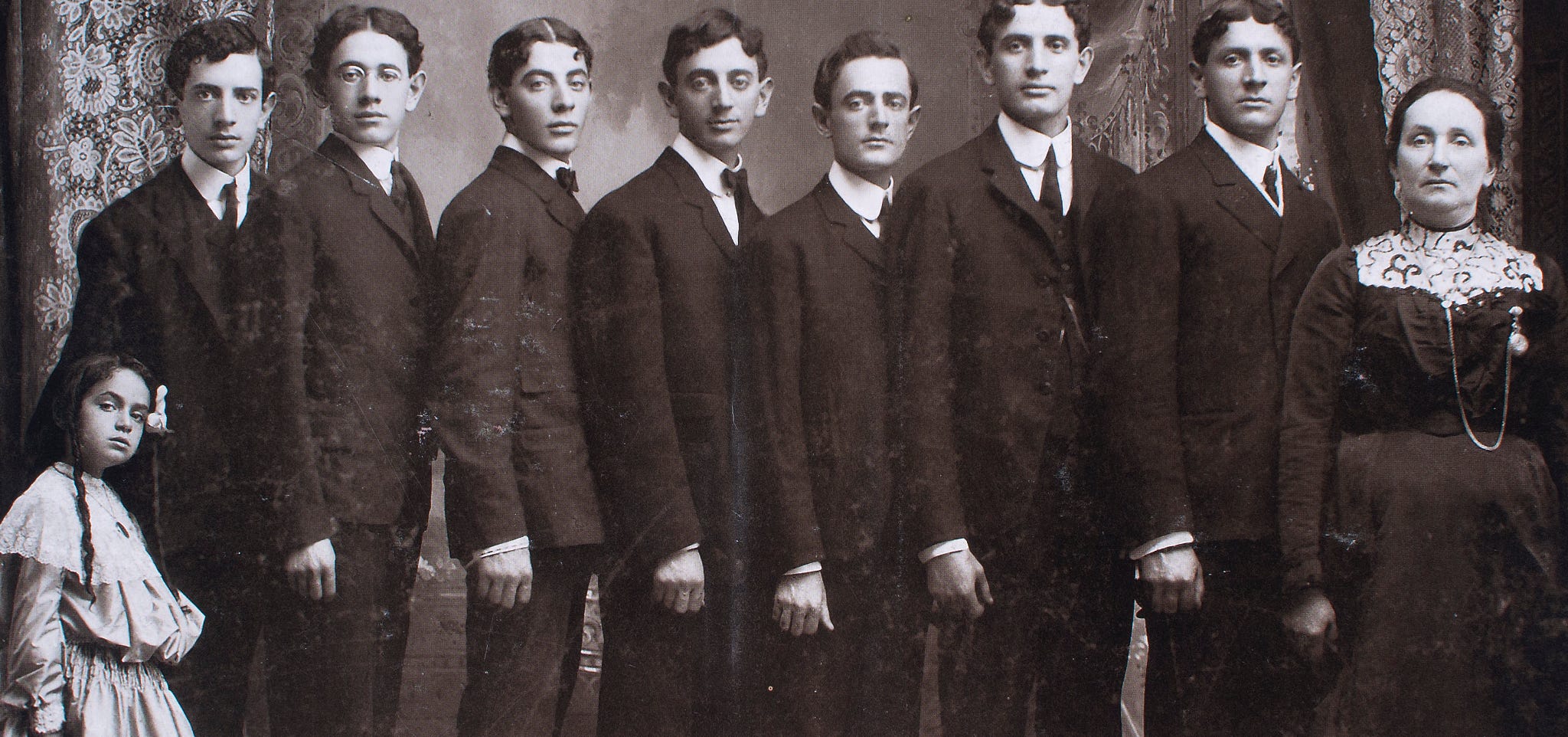
The relatives in the above photo have held my attention for decades, the family members staring back at me with serious looks on their faces, many of them still young, with complex and interesting lives ahead of them.
I thought I had come to a comprehensive understanding of their histories, having pored over countless documents, official records, photos, and oral histories. I felt close, in some way, to each one. But in October of 2025, those records, when shifted and aligned in a new way, birthed a surprising new insight that led me to believe something I had not previously imagined about this family.
The Discovery
It had taken me several years to determine the birthdates of the eight immigrant children and their parents. Those dates were found in various databases and pieced together through the likes of census schedules, draft cards, and naturalization records. Despite all of my research and all of the time I had spent thinking about these people, there was something that I had never done until recently: on August 8th, 2025, I sat down and wrote out the names and birthdates of the eight children (in order) in a vertical list, perhaps being the first to do so in generations.
Jan. 25, 1877: Louis, the oldest brother
Feb. 21, 1879: Jacob, my great-grandfather
July 23, 1879: Joseph
Dec. 25, 1883: Morris
(followed by Abe, Sam, Ben, and Sara)
When I looked back at the list, an obvious inconsistency jumped up and slapped me right in the face: my great grandfather Jacob Zif was born in February of 1879 in Lithuania, but his brother Joseph Berkowitz was born just five months and two days later.
This small fact led to an inescapable1 conclusion that startled, then intrigued me: that despite the photograph portraying a strong and united family, one of those eight siblings—Joseph Berkowitz—was not born of the same mother as any of the other seven siblings. A new picture emerged of this relative of mine, whose photo I had seen many times and whose personality had been described by many family members. Joseph was almost certainly adopted by Lipman and Amelia Zif in the humble town of Jonava, Lithuania in the late 1880s. Somehow, during all of the intervening years, no one in my extended family had ever spoken about an adopted child or appeared to have any knowledge of the situation. As far as everyone knew, Joseph was a son of Amelia, just like the other siblings.
Conjecture
It seems clear from the birthdates that Joseph’s mother couldn’t have been Amelia, but could Joseph’s father have been her husband Lipman? Could Lipman have had a child with another woman—and that child was later adopted by Lipman and Amelia? It seems an unlikely scenario; and why would Amelia agree to adopt a child from her husband’s illicit relationship anyway?
But there’s more.
In looking back at the “Berkowitz/Beckwith Boys lineup” below (youngest to oldest, left to right), I started to see how different Joseph was in appearance than the other boys:
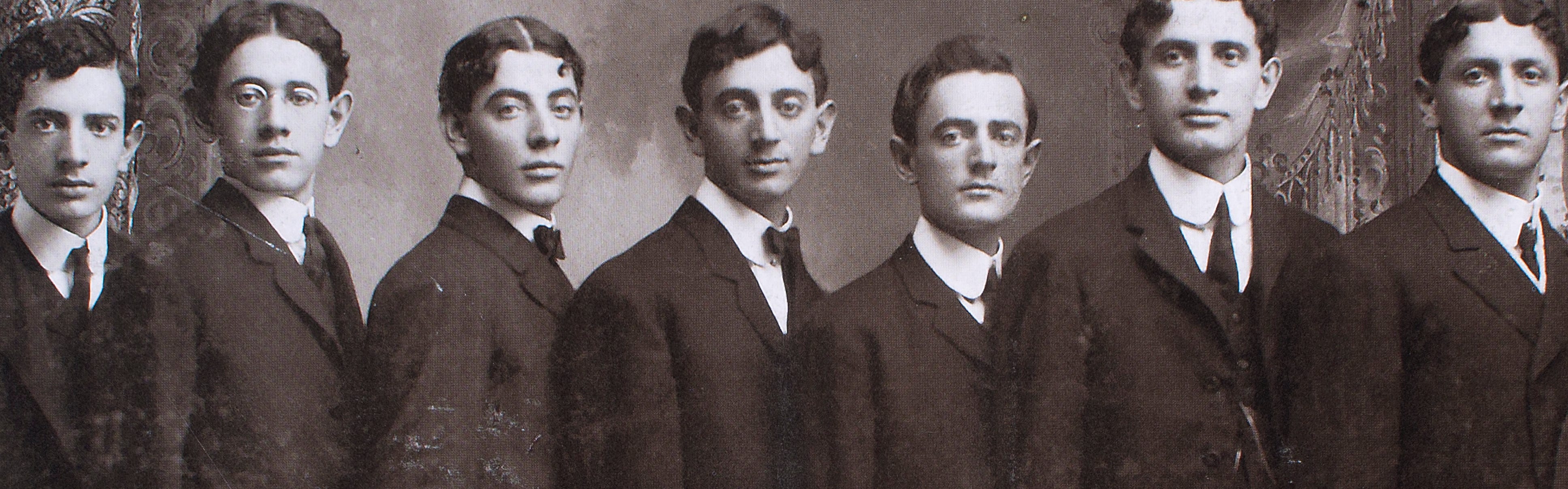
The shape of Joseph’s eyes and his nose seem different; he appears to be shorter and thinner and has sharper facial features and smoother hair than all the others.
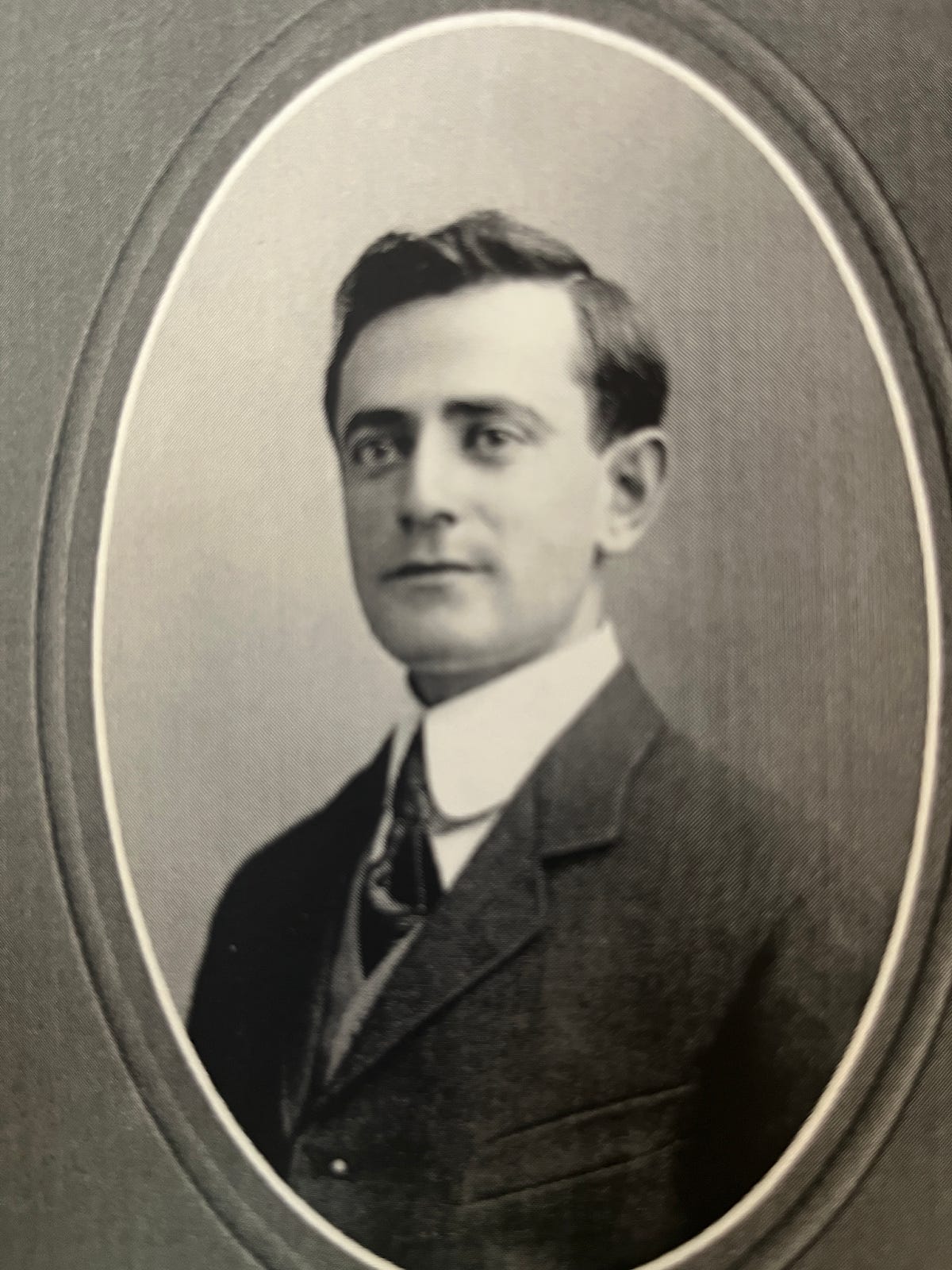
The next unanswered question was obvious: what circumstances led to Joseph’s adoption? What happened to his parents? As with many family mysteries, the truth can be elusive. In this case I couldn’t find any records that would shine a light on Joseph’s young life; all I am left with is conjecture.
My best guess is that five months after Amelia gave birth to Jacob Zif in Jonava, a different woman (perhaps living just a few streets away) gave birth to Joseph Whatever-His-Last-Name-Was. Then at some point over the next fifteen years, both of Joseph’s parents passed away, making Joseph an orphan. For whatever reason, Lipman and Amelia agreed to adopt the orphan Joseph and give him their last name, welcoming him as a new member of their family. By the time he settled in America, Joseph was simply known as “one of the Berkowitz brothers,” and was treated no differently than the six brothers that had called upon the same courage as Joseph to cross the ocean and start a new life.
What Became of Joseph?
Joseph became a U.S. citizen in 1906 and by 1920 owned a hardware store on Washington Street in Boston with his brother Sam. This store found its way into a 1923 Boston Globe article about a fight that took place there and a Boston Police motorcycle that fell into the wrong hands:
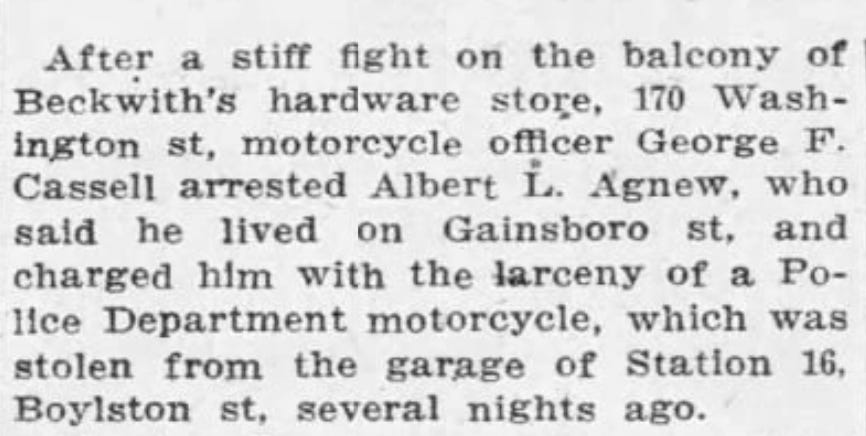
Joseph later ran the New England Bedding Company in South Boston. Thirty-seven years after coming to America, Joseph finally “tied the knot” (or “broke the glass”): he married Boston-born Cecile Pearlstein at age 53. He died just three years after their wedding. The couple never had any children together.
Was Joseph’s adoption really a “secret”?
To try to answer this question, I thought back to 1909, when the Berkowitz family was living in the old West End of Boston and about to move out of that crowded neighborhood and down to Dorchester (another Boston neighborhood). That year, Joseph and Jacob would both turn 30 years old. Berkowitz family members would certainly have gathered to celebrate each of those milestone birthdays (Mazel tov!) and couldn’t help but be aware that Joseph turned 30 only a few months after Jacob. It was not a secret. So why did none of the descendants of our family seem to know about this?
Joseph’s death in 1936 would have left a void: there were no descendants to ensure that the details of his life were passed down. The remaining family members (both parents had passed away by 1936) may also have felt a reluctance to bringing up the painful story of a boy who lost both of his parents to disease (or violence) and was then forced to start over with a new family.
Is there more that could be done to confirm my suspicions?
One approach would be to travel to Lithuania and find official birth records.
I would need to search for a list of all the births that happened on July 23, 1879, in Jonava (and maybe neighboring towns?) and try to confirm that there was in fact no “Joseph Zif” born on that day. I would then try to find a “Joseph” with a different last name who was born on the same date and in the same area (if found, that would then reveal the names of Joseph’s real birth parents).
Is this reasonable to attempt? What is travel to Lithuania like? Would I have to learn the language or have an interpreter with me? Are the records still there? Could I access them? What are the odds that a trip like that would end without finding anything new or useful?
What about genetics? We already know that there are no descendants of Joseph with whom we could compare DNA. I suppose digging up his remains (he is buried in a cemetery in Woburn, Massachusetts) and getting a genetic sample would help resolve the issue—but doesn’t that only happen in the movies?
“The knowledge we don’t uncover stays hidden.”
- Nathan Grawe, Boston Globe, November 30, 2025
Every family has stories they tell—often funny, or heroic, or inspiring. They may also have stories that they don’t want to tell. In my family’s case, there are more stories I’ve run into (suicide and wrench-stealing and price-gouging, oh my!). When you discover stories that don’t fit the narrative you’ve built for yourself, do you share those stories?
Whatever it is that you find out about your ancestors, each story has the potential to confuse, to delight, to frustrate, to surprise, and to entice those who cannot help but pull on the thread of the fabric of each mystery. Each new story will also both complicate and enhance one’s understanding of the very real lives of people whose stories should not be forgotten.
Even if Joseph had been born prematurely, Amelia would have had to become pregnant immediately after giving birth to Jacob. So while this is not an impossibility, it certainly strains credulity to believe they were born of the same mother.
Wow! Great research and family history, told well. Take that trip to Lithuania. Cheap flights connecting from London hub to Vilnius on Ryanair and Google translate can help you along the way.